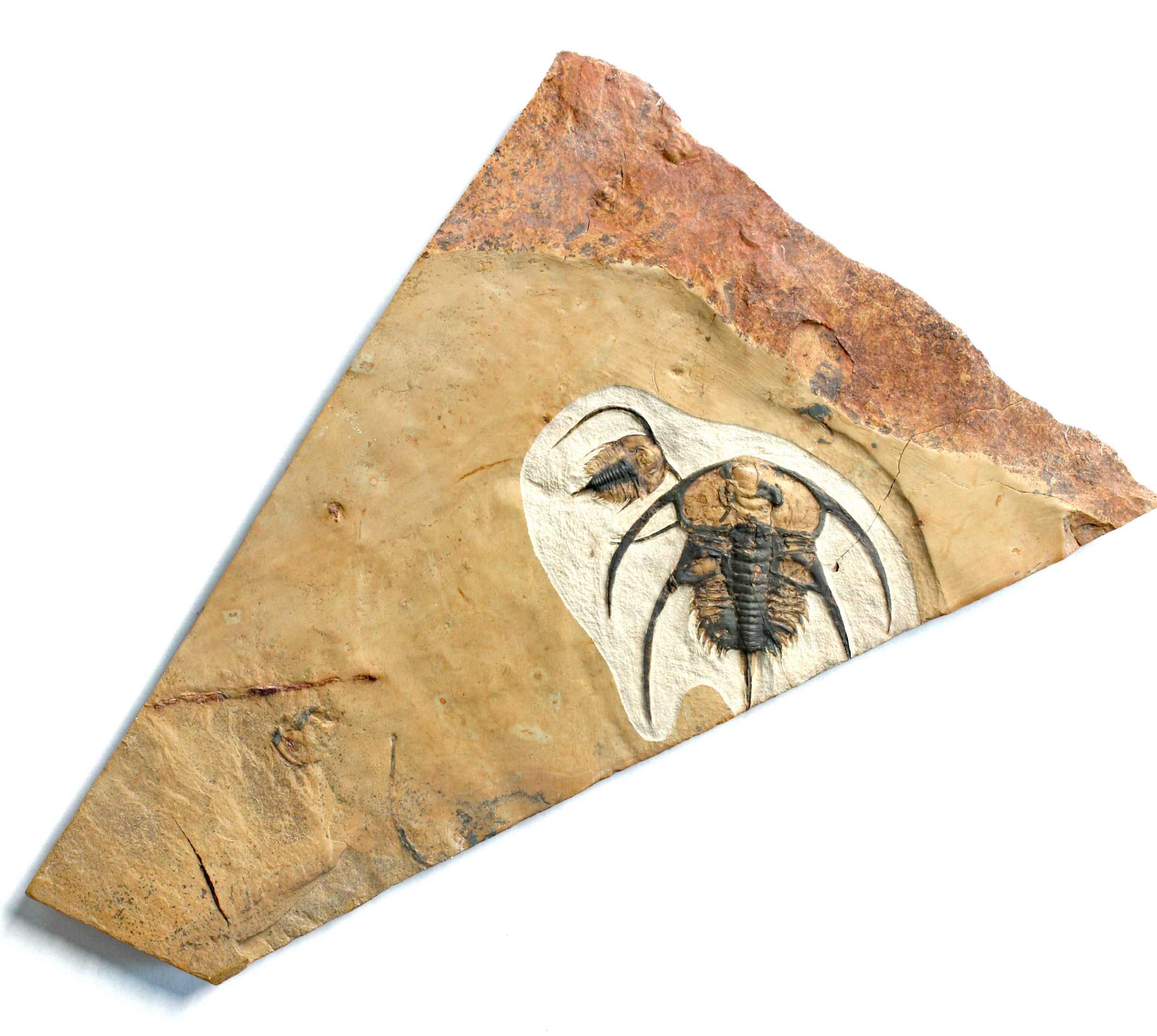
Bristolia bristolensis
Lower Cambrian
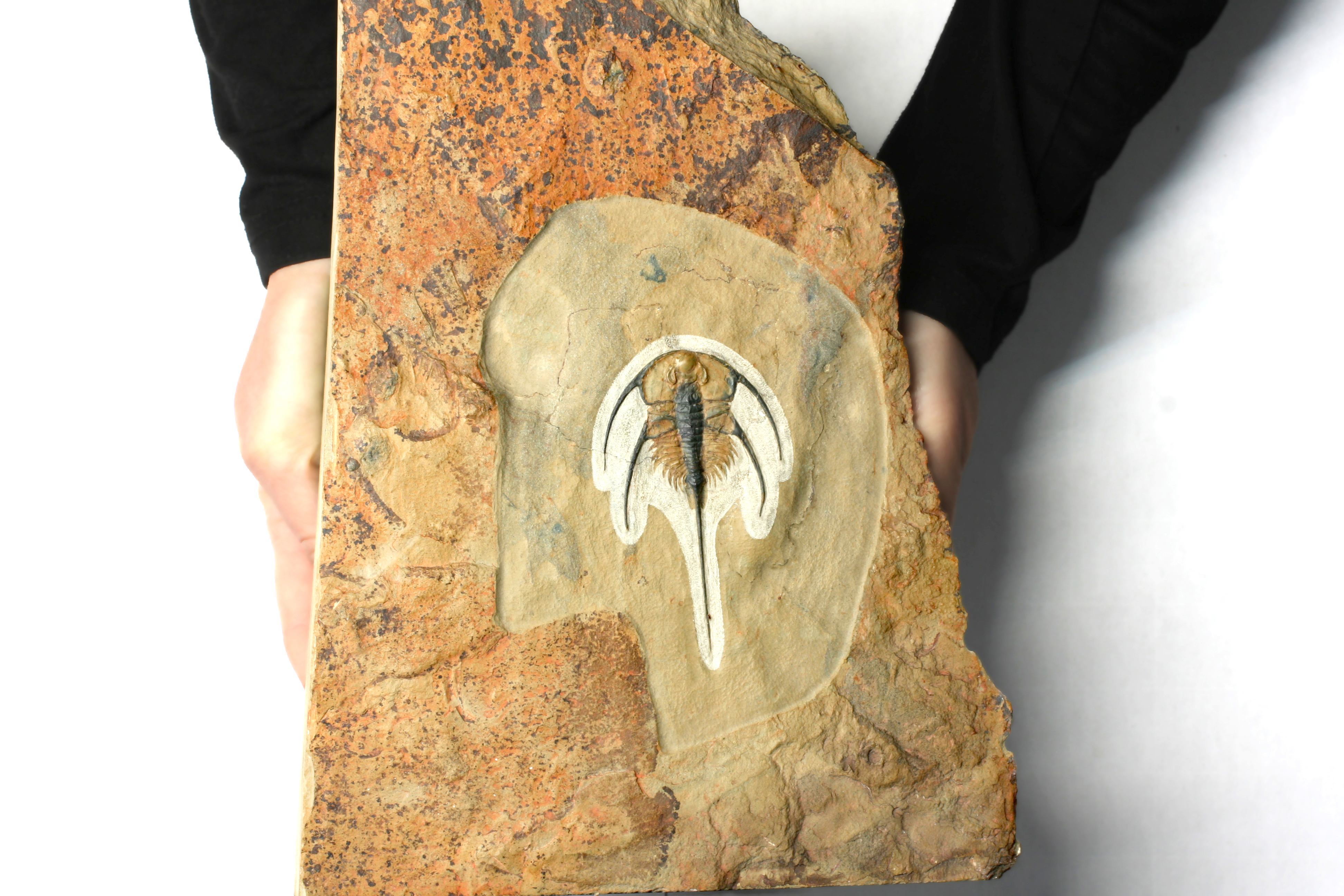
Bristolia are among the most sought after fossil specimens, trilobite or otherwise. Private collections, museums and fine art galleries gobble up these beauties when they become available. Their beauty, derived from their long and wide spanning spines, is undeniable. In the late 1990’s and early 2000’s, the remote high desert localities that produce these incredible trilobites were accessible. Many a long day was spent under the hot burning sun splitting ton after ton of host rock to no avail. Days could easily turn into a week with still no solid or complete Bristolia bristolensis. And B. bristolensis is the most common of the Bristolia species. When one finally splits out a complete specimen, it was usually on cross section, or splitting damage occurred, meaning flakes had to be collected and carefully wrapped. It was anyone’s guess if what was found would turn out in the prep lab. Experience proved only approximately one in ten of those complete specimens would become a truly epic specimen. The rest, each one having required a day, two days, sometimes more, splitting rock in the field, plus countless hours in the prep lab, were destined for the B grade label. The specimens here on this site represent the absolute best of the best that have ever been found and prepared.
Species Overview
Bristolia bristolensis lived approximately 515–520 million years ago during the Early Cambrian. During this interval, Earth’s supercontinent fragments were still drifting and coalescing, broad shallow seas covered large portions of western North America, and the oceans teemed with rapidly diversifying early animal life. Land plants had yet to appear, terrestrial ecosystems were barren, and atmospheric oxygen levels were continuing their long rise. The Solar System was fundamentally comparable to the one we inhabit today. These trilobites have completed roughly 2.25 cosmic (galactic) years aboard Spaceship Earth — one full galactic rotation takes about 230 million years. Over that journey they have travelled approximately 300 quadrillion miles (3 × 10^17 miles), the great majority of that distance while entombed in rock.
Geological Context
Bristolia bristolensis is from the Lower Cambrian (Series 2, Stage 4). It occurs within the Olenellus Zone and is associated with the broader Bristolia faunal interval in shallow marine strata of the Great Basin region. The species is typically found in fine-grained siliciclastic sediments, especially dark shales and siltstones deposited in low-energy, subtidal settings on a broad carbonate-siliciclastic shelf. These quiet-water deposits formed during transgressive phases of Early Cambrian sea-level change and often preserve a characteristic shallow-marine benthic community.
Classification
| Class | Trilobita |
| Order | Redlichiida |
| Suborder | Olenellina |
| Family | Biceratopsidae |
| Genus | Bristolia |
| Species | B. bristolensis |
Fossils and Preservation
Like other members of the genus, B. bristolensis is typically small at adulthood, with cephala generally under 1 cm in length. It is distinguished by its genal spine morphology and intergenal angle, which is deflected at approximately 80–95° relative to a transverse line. The cephalon is semi-circular to rectangular, and the species possesses the typical short thorax, extended opistothorax, and long prominent terminal axial spine or telson. Complete articulated specimens are exceptionally rare; most recovered material consists of isolated cephala or partial thoraces preserved as compressed molds in shale. High-quality surface detail is extremely rare.
Ecology and Paleoecology
Bristolia bristolensis inhabited shallow marine shelf environments during the height of the Cambrian radiation. It frequently occurs with other olenellid trilobites, including species of Olenellus, Mesonacis, Paranephrolenelus and additional Bristolia taxa, in relatively low-diversity benthic assemblages. Morphological variation within the species, particularly in spine positioning and cephalic proportions, may indicate responses to environmental gradients or different growth stages. As a benthic arthropod, it likely lived near the seafloor and was probably a detritivore or opportunistic feeder in these early Cambrian communities.
Scientific Significance
Bristolia bristolensis is an important component of Lower Cambrian olenellid diversification and helps shed light on the rapid evolutionary changes occurring within the group as they were quickly approaching extnction at the end of the Lower Cambrian. Its distinctive morphology and extremely restricted stratigraphic occurrence make it useful for biostratigraphic correlation across the Great Basin. The presence of measurable variation in features such as intergenal angles contributes to studies of intraspecific plasticity and adaptation. The overall rarity of well-preserved material highlights the special taphonomic conditions required for the preservation of these delicate early trilobites and adds to our understanding of Cambrian faunal dynamics in Laurentia.